Alexander Hall wrote a report on the recent ICHM meeting held in Manchester, titled “Working Atmospheres.” Click here to read his blog post.
On December 3, 2013, the , the Meteorological Society of Cuba (SOMETCUBA) held the First National Meeting on History of Meteorology in Havana. Click here to read the meeting memoir (pdf).
London Arts and Humanities Partnership is pleased to invite applications from outstanding candidates for AHRC/LAHP Doctoral Training Awards for 2014-15 entry. Up to 80 studentships are available for postgraduate research students studying Arts & Humanities at University College London, King’s College London, or School of Advanced Study (University of London) from London Arts & Humanities Partnership (AHRC Doctoral Training Partnership) 2014.
(cross post from the Climate History Network)
Applications are sought for a two-year National Science Foundation (NSF) funded postdoctoral fellowship at the intersection of environmental history, the history of science, and political ecology at the University of Oregon. The postdoctoral fellowship is part of Professor Mark Carey’s NSF CAREER grant (#1253779) on “Glaciers and Glaciology: How Nature, Field Research, and Societal Forces Shape the Earth Sciences” (see links below for more information). Applicants should have a research agenda that intersects with this NSF-funded project by examining historical glacier-society interactions, the history of glaciology, the history of the earth sciences, climate-society dynamics, the role of dynamic environmental change in the evolution of scientific knowledge, or the history of field-based sciences. Applicants may also have broader or more theoretical connections to the project, or they may have related regional specializations in the history of Greenland, the Arctic, Antarctica, or high mountains such as the Himalaya, Alps, or Andes.
Association of American Geographers (AAG), Annual Meeting
April 8-12th 2014 in Tampa, Florida.
Organized by Lars Böcker (Utrecht University) and Mario Cools (University of Liège)
Intuitively, weather plays an important role in everyday life. How often do we not expose ourselves to cold, heat, sun, rain, snow or wind, or do we refer to these same elements at the coffee table or when writing post cards from a holiday address. Recently, weather has also emerged as an important policy aspect, with climate change, urban microclimates, health, accessibility, livability and subsequent aims to reduce car mobility and promote healthy but weather-exposed transport modes and physical activities high on the agenda. Yet although the influence of weather on daily life has been pervasive and its societal relevance never more pronounced, current interdisciplinary scientific debate on how weather shapes everyday life still requires further research to complete the areas that are under-investigated and provide additional empirical evidence to support policy-making. We thus seek to organize a session (or sessions), which address(es) the role of weather in daily life in its broadest sense, including behavioral or psychological responses to weather by diverse societal groups in a diverse range of geographical, cultural and climate contexts. We welcome submissions that examine topics including but not limited to:
ICHM and CHSTM Workshop
Manchester 21 – 22 November
Centre for the History of Science, Technology and Medicine
Organizers: Vladimir Jankovic (Manchester) and Samuel Randalls (UCL)
There has been relatively little historical and critical research on applied and commercial meteorology compared to that on academic research and weather forecasting. Through the twentieth century, however, commercial meteorology and industrial climatology became increasingly prominent, often attributed to a post-WW2 glut of available meteorologists and an emerging number of corporations exploring, for example, air pollution, emergencies and business interruption issues. Governments around the world have supported the development of an explicitly commercial meteorological sector to provide competition to public services in areas of weather forecasting and consultancy, although public organizations are still generally charged with collecting meteorological data and producing emergency forecasts.
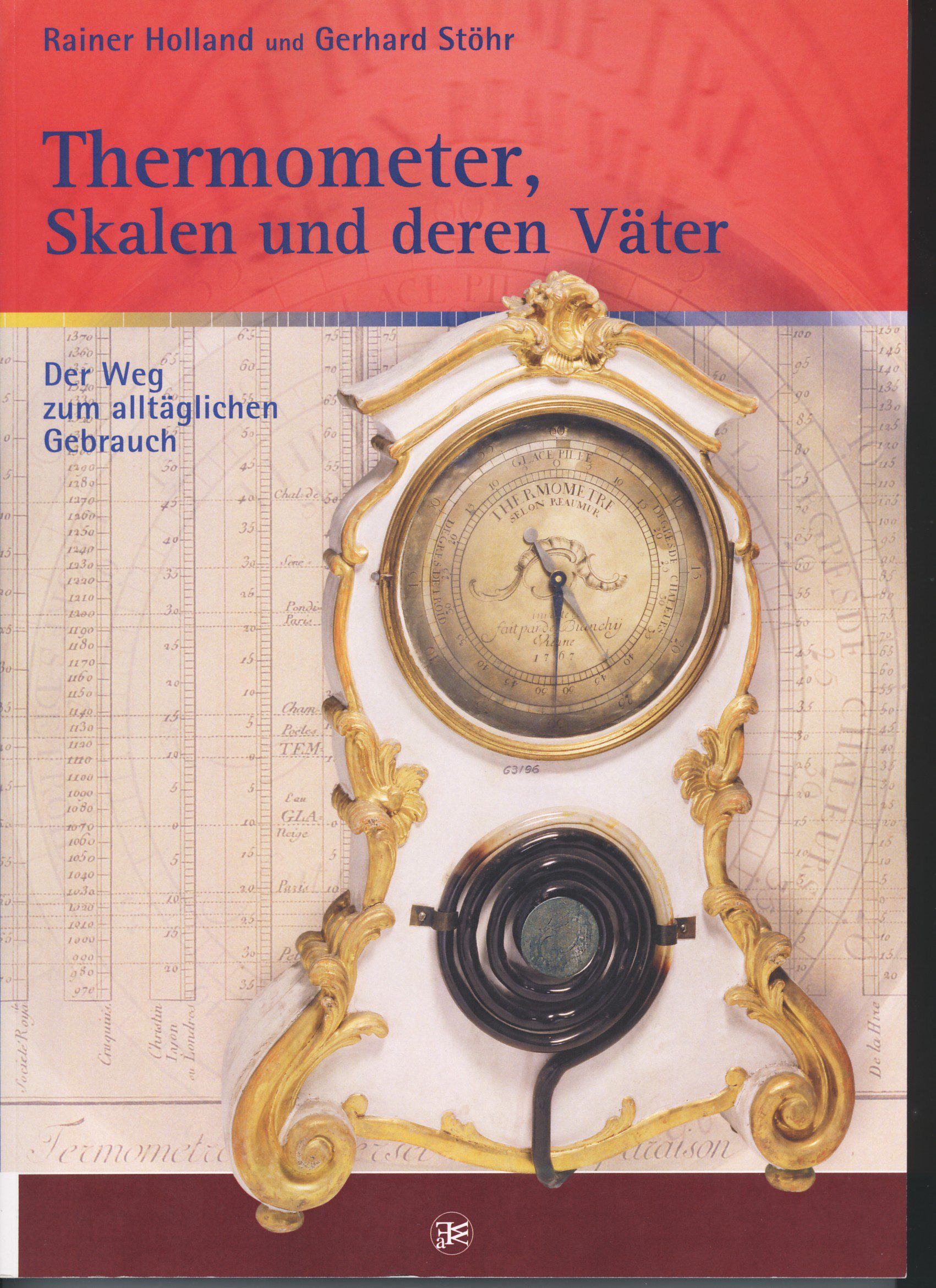
New book on thermometers
Holland, Rainer und Gerhard Stöhr, Thermometer, Skalen und deren Väter. 210 Seiten, 75 Tafeln und Abbildungen, 2013, Selbstverlag Riedlingen, ISBN: 978-3-00-042-032-0, Preis: 34,80 €
This is a wonderful book on the development of thermometers, which gives a lot of information, pictures, and references. It includes special thermometers and the transformation of their scale in Celsius or Fahrenheit. During the German-Austrian and Swiss Meteorological Conference (DACH 2013), which took place in Innsbruck (Austria) in September 2013, the authors received the Paulus Price for the best publication in history of meteorology.
Further publications describe the handling of mercury barometers and the history of hygrometers:
- Holland, Rainer und Gerhard Stöhr, Quecksilber-Barometer Handbuch.114 Seiten, zahlreiche Abbildungen, 2012, Selbstverlag Riedlingen, ISBN: 978-3-00-038294-9, Preis: 25,80 €
- Holland, Rainer und Gerhard Stöhr. Geschichte der Hygrometer. 110 Seiten, ca. 80 Abbildungen, 2011, Selbstverlag Riedlingen, ISBN: 978-3-00-033734-5, Preis: 18,90 €
(Cross post from H-Environment, via the Climate History Network)
On the 17th October 2013, the Centre for Social and Political Thought and the Centre for World Environmental History at Sussex University will be hosting a joint one-day workshop on how the humanities and social sciences have engaged with issues around climate change. Within the last two decades, discussions around climate change have expanded from the natural sciences to include the social sciences and humanities. It is now clear that climate change has political, economic and social consequences. However, until now academic discussions on the topic have focused primarily on policy implementation and the consequences of such actions. Furthermore, the historical dimensions to the debate have been severely neglected. Therefore, with this in mind, the aim of the one-day workshop will be to explore different approaches to the understanding of the climate change phenomenon with a view to further enhancing the inter-disciplinary approach to the subject. Thus, this workshop will provide an opportunity for, among others, social theorists, environmental activists, environmental historians and intellectual historians to come together to exchange ideas about how to understand the ‘climate change phenomenon’.
For further information please e-mail Alex Elliot (aje28@sussex.ac.uk) or James Cullis (J.Cullis@sussex.ac.uk)
Japan Climate Data Project
(Cross post from the Climate History Network)
In 2013, researchers from Seikei University, Teikyo University, and Tokyo Metropolitan University created the new Japan Climate Data Project. This collaboration aims to recover and catalog Japan’s extensive historical climate records–including weather diaries and phenological observations–as well as early instrumental measurements. The data section is still in progress (as of 8/2013) but should eventually contain extensive digitized records and later English translations of data. In the meantime, the site contains a bibliography of publications based on the collections.
For more, see http://climatehistorynetwork.
(Cross post from the Climate History Network)
Last week in Munich, the International Society for Historical Climatology and Climate History was formally registered and held its first official board meeting during the European Society for Environmental History biennial conference. The new society also inducted its first honorary members: Emmanuel Le Roy Ladurie, Christian Pfister, and Geoffrey Parker. The board discussed links with journals, a publication series, and a projected conference for 2014. The society will open formal membership soon. For now, climatehistorynetwork.com will host the society’s webpage and announcements.