
By Lotta Leiwo (University of Helsinki), Rebekah Higgitt (National Museums Scotland), and Tamara Caulkins (Central Washington University)
Amidst mild coastal Norwegian winter weather in December 2024, a group of thirteen humanities researchers convened in Stavanger for a workshop on weather and weathering. The days offered sunshine, coastal fog, and mist—as well as fruitful academic discussions on studying weather and weathering. We gathered at the Greenhouse incubator library at the University of Stavanger for the workshop “Affect and Material Cultures of Weathering: Histories, Temporalities, and Spaces,” organized by MSCA postdoctoral researcher Animesh Chatterjee in collaboration with Melania Buns (the Greenhouse, University of Stavanger).
During the workshop, each of us presented our approaches to studying weather and weathering within the histories of science, medicine, and technology; environmental history; architectural and design history; and literary and cultural studies. The aim was to explore the linkages between affect, material cultures, climate, and weather from the late eighteenth to the mid-twentieth century.
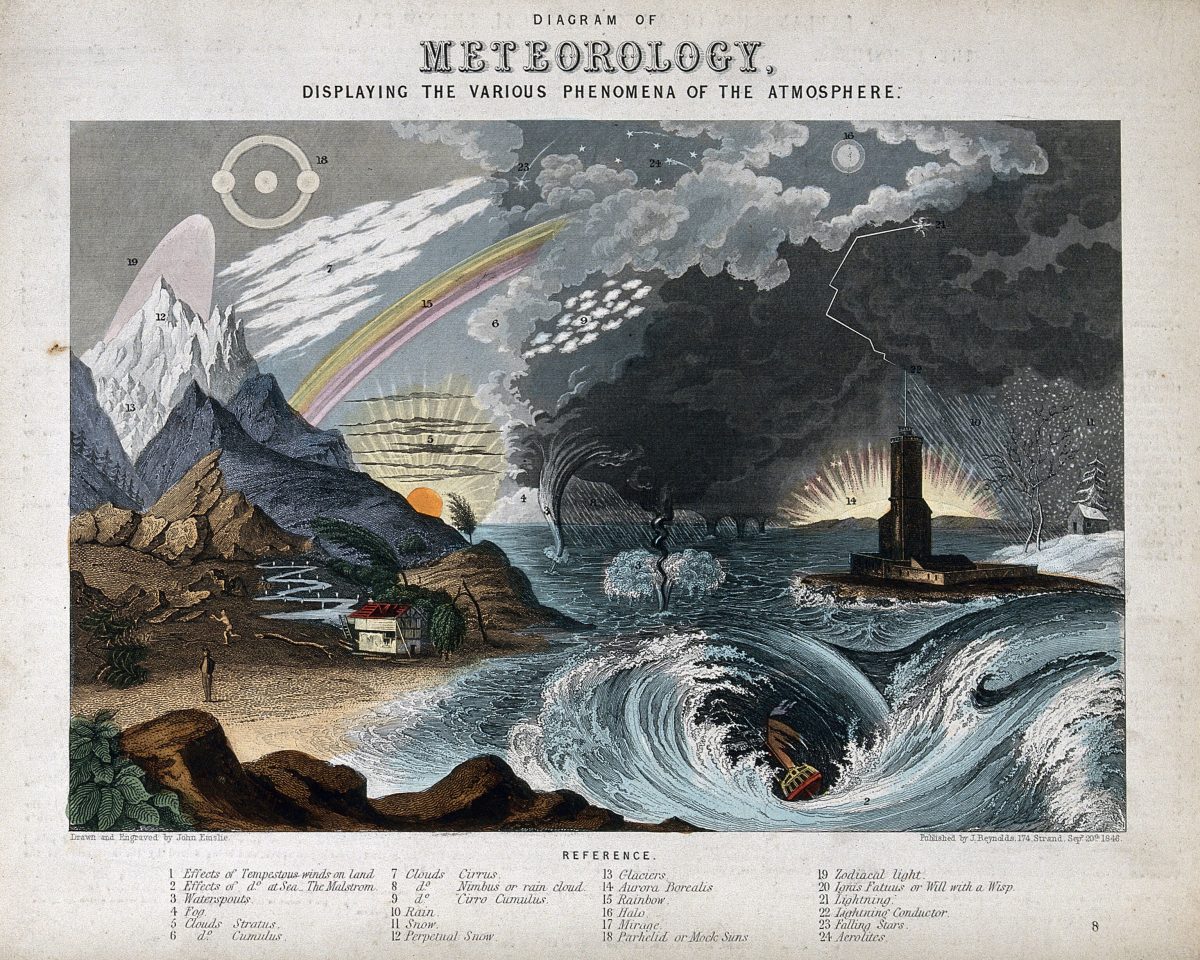
An introductory session of visual lighting talks, in which each participant spoke about one visual image, was especially illuminating and sparked the idea for our Sourcebook. This Sourcebook, which we are proposing as an open access publication, will encompass textual, visual, and material primary sources geared towards historians wanting to take more notice of the climate and weather in which their narratives emerge. The call for proposed entries will be open until September 4, 2026.
In this post, we—Lotta, Rebekah, and Tamara—introduce our academic perspectives on weather and weathering and hope to inspire readers to contribute to the Sourcebook for Histories of Weather and Weathering, which we are editing. We acknowledge that weathering has been defined in many ways in academic research and have therefore kept the call open, without limiting contributions to a single interpretation of the concept.
Lotta: Migrant-Settler Weather in North America
As an interdisciplinarian folklorist, I am drawn to everyday lives and practices—the “mundane,” vernacular, and grassroots levels—of human experience and communication. I have long been interested in history, and my research is grounded in archival work and in the interpretation of archival sources in tradition archives. While I now primarily study newspapers, periodicals, and magazines printed by Finnish migrant-settlers in early 20th-century North America, I have recently begun conducting visual analyses of photographs and cartoons to understand how weather is conveyed and how it can be studied in these media to provide a more nuanced analysis of textual sources.
In the grand scheme of North American colonization, Finns played a relatively small role; some 400,000 migrated to the continent from the 1880s to the 1920s. However, they exemplify a broader phenomenon of the period: mass migration from Europe to the Americas and the settler-colonial ideas, worldviews, and projects that justified it. I first encountered weather-related topics while writing my master’s thesis. Focusing on historical newspapers, I noticed that Finnish migrant-settlers—the ordinary reader-writers of Finnish-language papers published in the U.S. and Canada—wrote extensively and repeatedly about weather. This recurring pattern of communication led me to study weather and weathering in my dissertation.
The concept of terra nullius is widely used to denote the colonial idea of empty land in North America awaiting white cultivation, development, and “civilization.” The core logic of settler colonialism centers on claiming, homemaking, and extraction on the land. However, as I have begun to study Finnish cultures of weather, I have started to consider how the air/sky (weather) fits into this picture. Métis scholar Zoë Todd (2016, 8) has proposed the concept of aer nullius to denote the supposed emptiness of air and sky and the framing of climate as “a blank commons” to be filled with Euro-Western ideas. Todd’s work is grounded in contemporary climate change and, with good reason, as they critique Euro-American scholarship for erasing and excluding Indigenous perspectives and theories on weather and climate.
Inspired by Todd’s notion, I am interested in how aer nullius—along with other conceptions of weather, weathering cultures, and everyday experiences of weather—were communicated in the past by Finns in North America. Amid the pressing reality of living in an era of human-induced climate change, I sometimes find myself struggling to give reason to study history and not focus on very lively academic discussions on climate change and the Anthropocene. I have come to justify my historical research on migrant-settler weather and weathering by arguing that we can learn from how migrant-settlers adjusted to, resisted, and acclimated to climate change ex situ—that is, the experience of climate change resulting from their relocation to regions with different climates. I argue that these assimilation practices can inform us how to better—and what to avoid when we attempt to—culturally adapt upon the climatic change we are currently experiencing in situ as human-induced climate change that alters the physical characteristics of weather in the places humans live.
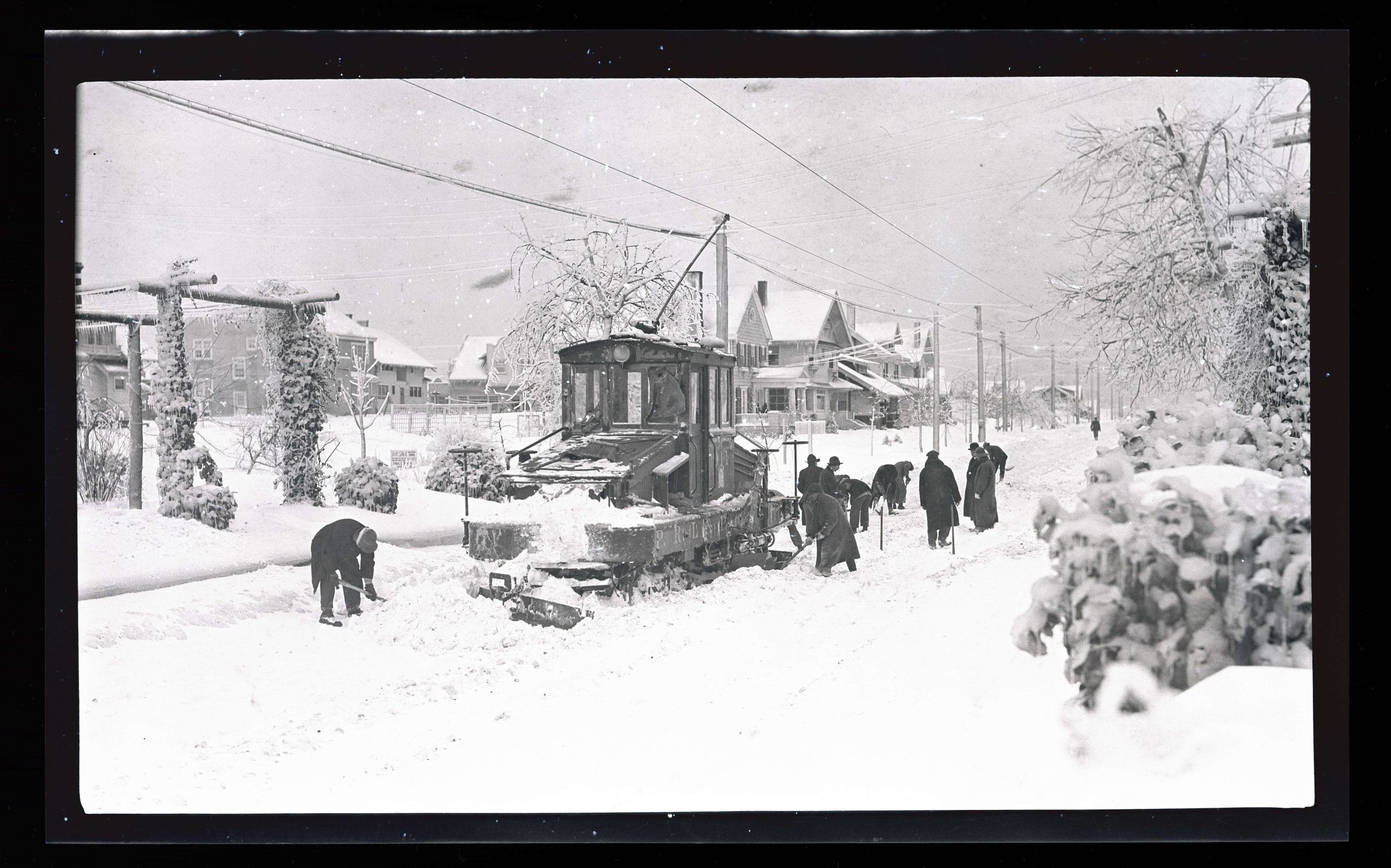
The image below showcases the effects of a rare snowstorm in Portland, Oregon, in 1916, followed by a silver thaw. The photographs drawn from the Oregon Historical Society collections provide valuable contextual information—rather than serving merely as visual decoration in my dissertation—for a folklorist analyzing weather-related texts written by Finnish socialist women in North America at the time. These texts written by reader-writers of Finnish-language socialist women’s newspaper Toveritar (The Woman Comrade) discuss weather events and weathering from a working-class perspective and examine how its effects and perceptions are linked to labor and daily life of Finnish migrant-settlers.
Rebekah: Meteorology and the Museum
As a curator and a historian of science, I am used to working with material and visual as well as textual sources. Among the objects that I am responsible for at National Museums Scotland are those categorized under Meteorology. These arrived at the Museum at different times, and from a range of sources, but include a group of meteorological instruments that were bought at the beginning of the 20th century for the new School Gallery. Today, a museum might use such instruments to help audiences understand the relationship between measurements of local weather and models of global climate, encouraging awareness of what we know and what is at stake as we experience a changing climate. What was their role a century earlier?
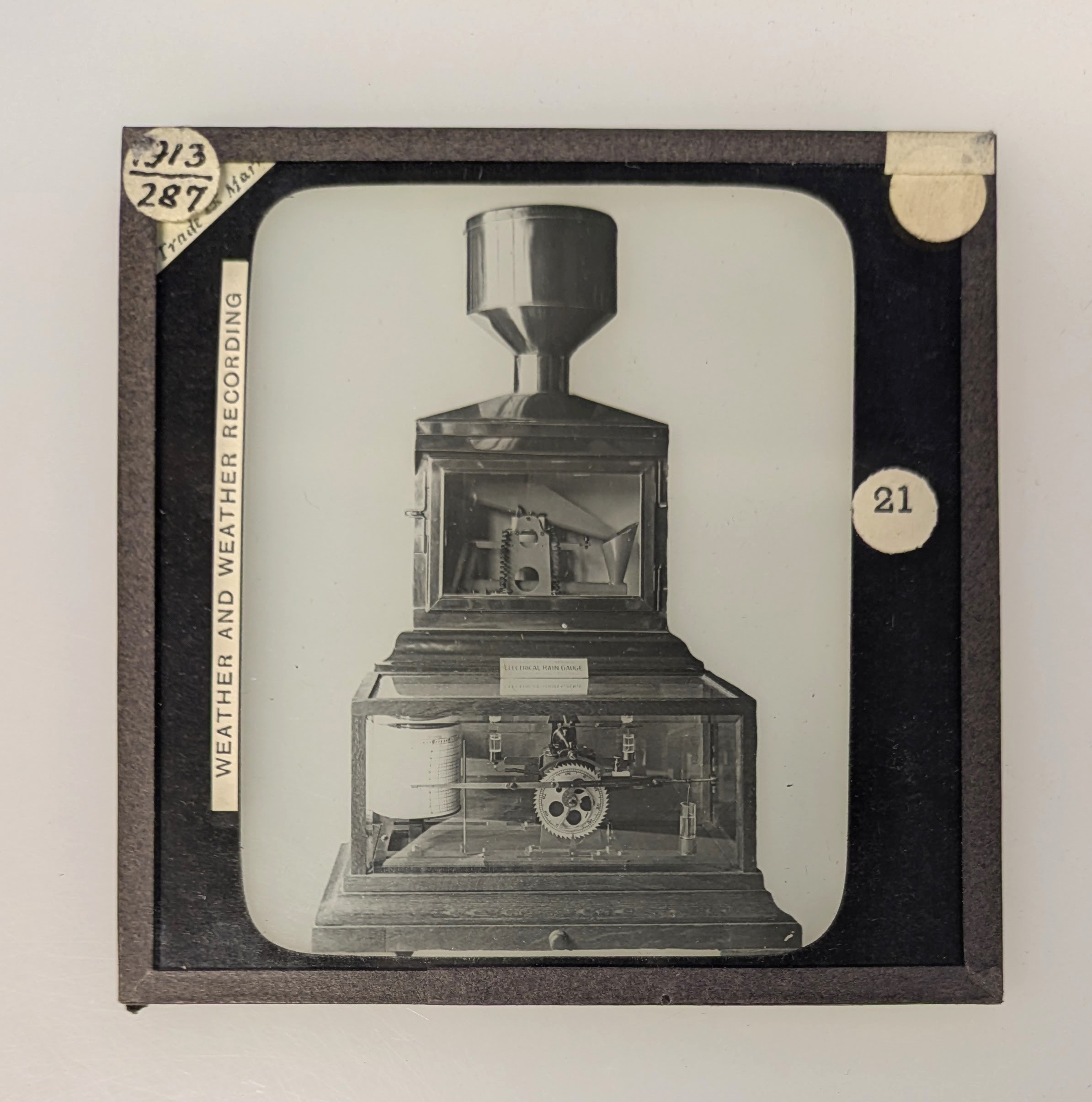
The lantern slide pictured below shows one type of instrument used at the Museum—an electrical recording rain gauge—and represents one way in which it was presented to audiences—through illustrated lectures and lessons. It helped me understand the Museum’s role in taming and redefining weather experience through the structures of meteorological measurement, its link to contemporary educational and museological trends and a wider shift in how city dwellers understood local weather.
Meteorological instruments owed their prominent place at the Museum to the Nature Study movement. This was promoted by the Scottish Education Department, which took over responsibility for what was then known as the Royal Scottish Museum, in the early 20th century. Nature walks and school gardens were key, but the Museum found a role through the emphasis on “seasonal studies” and instrumental observation, which were intended to encourage schoolchildren to notice change, connect causes and effects, and learn about measurement and recordkeeping. This worked as an elementary introduction to scientific subjects but, more broadly, aimed to shape children into rational, reasoning, observant and moral adults. The experience of weather was redefined into its measurable components: inches of rain, degrees of temperature, speed of wind.
Nevertheless, the experiential was not absent. The Museum had to earn its place as an educational resource and an emphasis on unusual readings—the rise and plunge of a pen tracking exceptionally heavy rain on a recording drum; the monthly record that was literally off the chart—could be tallied with memories of the event. Meteorological instruments making live recordings on gallery, or illustrated in lantern lectures, demonstrated the connection between weather effects and weather records. The working instruments and rainfall record were prominent enough to have been used by city planners and of occasional interest to journalists and (presumably) their readers. With such tools, the Museum helped train both children and adults to read weather through meteorology.
Tamara: Historicizing Technologies of Climate Control in the Greenhouse
As a historian of science and environmental historian, I am deeply interested in what the natural world presents to us, how people in the past have studied it, and how their actions and ours have modified the planet we call home. I do not believe all “artifice”—as in making art or using technology to change our lives—is bad; only that it can be done well or badly. My current research delves into the history of botanical conservatories as a space where climate control has been practiced through technologies of glass construction, heating, and ventilation. The creation of these artificial greenhouse climates fosters a sense that technology can solve our climate problems, but that trust in technology may not be transferrable to the problems we are facing in the larger world.
At my local regional university, I teach climate change and sustainability in the military science leadership program. As Jacob Hamblin has demonstrated in his book, Arming Mother Nature (2013), U.S. military scientists were conducting research during the Cold War with the aim of using climate manipulation as a weapon against enemies. In the process, they discovered that the climate of the entire planet was already being altered by human activities including industrial agriculture, deforestation, and, particularly, by burning fossil fuels in heating and transportation. With that knowledge, the U.S. military, an institution that is one of the world’s largest emitters of greenhouse gases, could play a significant role in combating the social, environmental, and political risks posed by climate change. Reducing the military’s carbon footprint and taking other measures to mitigate environmental harm could make a significant impact on national security. In my class sessions, I work with students to help them see the danger that climate change presents. By identifying extreme weather events, droughts, floods, and other climate-related disasters as tangible enemies, I encourage future officers to take action in support of renewable energy sources and other sustainability measures wherever they are stationed.
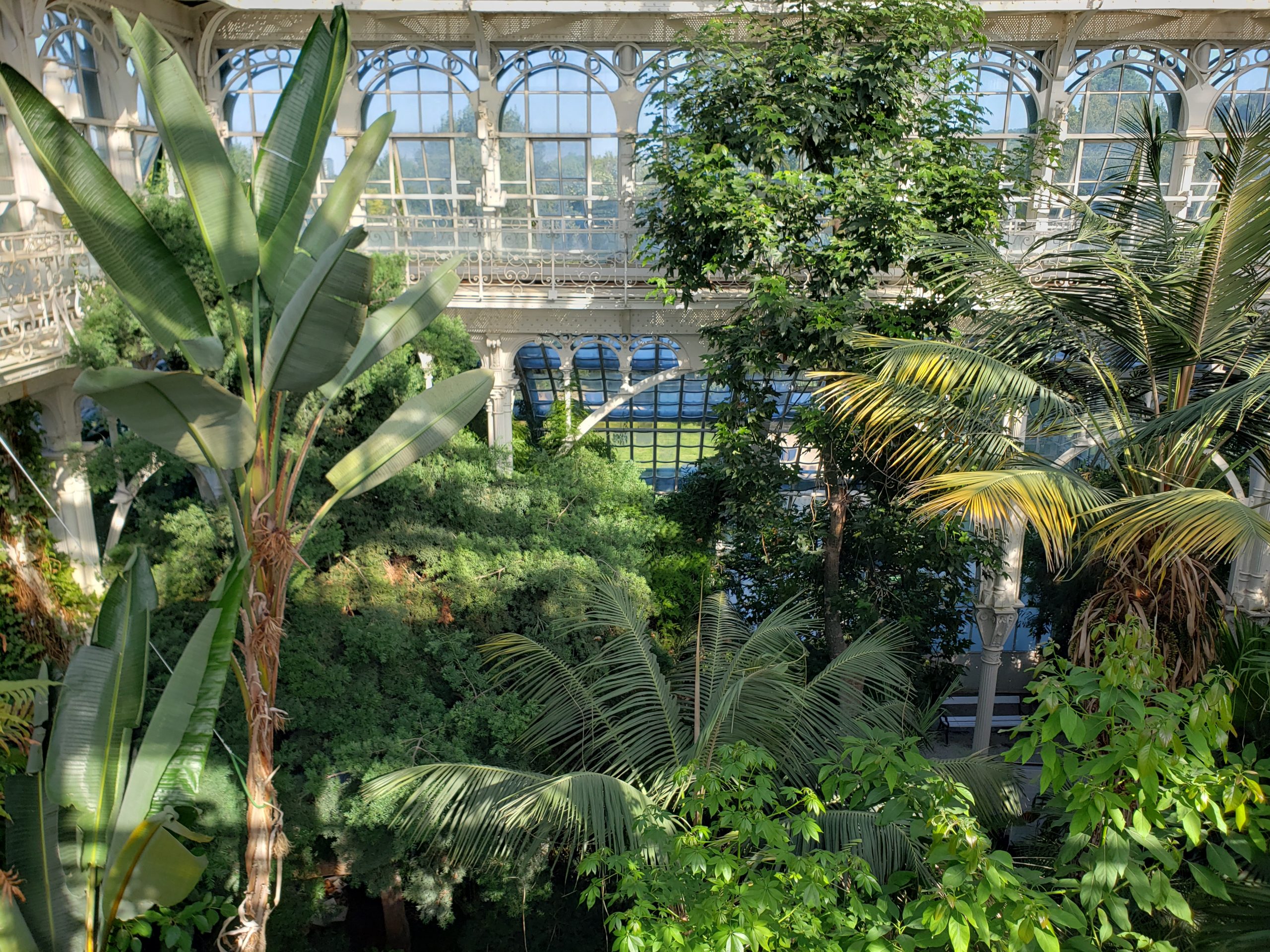
In my research, I have been looking at social and technological dimensions of botanical conservatories. The “greenhouse effect” is a common metaphor used to describe the earth as rapidly warming due to CO2 and other emissions; however, the history of physical greenhouses in shaping the cultural imagination around global warming has been largely overlooked. In 1896, when Svante Arrhenius mathematically demonstrated that carbonic acid released from the burning of coal could affect global temperatures, he was writing at the height of elaborate conservatory construction, which included the greenhouse complex of Leopold II built twenty years earlier in Laeken, Belgium, and the largest conservatory in the world at the time: the Palmenhaus at the Schönbrunn summer palace in Vienna which had been completed in 1882. As this image suggests, the Palmenhaus itself is the artefact that I am using to understand how people were thinking about climate and weathering.
My experience of this botanical conservatory included seeing a cluster of mushrooms peeking out from under a bench, not likely a planned addition to the flora of the greenhouse! This prompted reflection on the appearance of control that the greenhouse represents. In 2008, a 170-year-old palm tree that refused to stay within the bounds of the glass ceiling had to be cut down. Plants and other living beings in this building do not always accommodate the wishes of the humans who care for them. While technologies to control and recreate a foreign climate in a botanical conservatory are impressive, these technologies are limited. In those moments, it is worth paying attention to what is beyond our control and to what we can learn by more closely observing the natural world.
The Sourcebook
Here, at the end of our blog post, we would like to include a reminder about the Sourcebook. The idea for a Sourcebook of Weather and Weathering emerged from these interests presented in the initial workshop. This was followed by further discussions in conference settings, and now in this blog post. We recognize the value of learning from scholars in other fields working on weather and weathering. We believe that varied perspectives on sources related to weather and weathering could serve as a starting point for historians to view weather as a valuable lens for understanding human histories. We invite you, dear reader, to join us.
Please see the full Call for Contributions for more information about the book’s themes and aims, the range of sources and types of analysis we have in mind, the planned timetable, and how to submit queries or contributions.
Cited Bibliography and Further Reading
Drouet, Laura, and Olivier Lacrouts, eds. 2024. Greenhouse Stories: A Critical Re-Examination of Transparent Microcosms. Onomatopee.
Foer, Jonathan Safran. 2019. We Are the Weather: Saving the Planet Begins at Breakfast. Farrar, Straus and Giroux.
Golinski, Jan. 2007. British Weather and the Climate of Enlightenment. The University of Chicago Press.
Hamblin, Jacob. 2013. Arming Mother Nature: The Birth of Catastrophic Environmentalism. Oxford University Press.
Hulme, Mike. 2017. Weathered. Cultures of Climate. Sage. https://doi.org/10.4135/9781473957749.
Kohlstedt, Sally Gregory. 2005. “Nature, not Books: Scientists and the Origins of the Nature-Study Movement in the 1890s’, Isis 96 (3): 324-52. https://doi.org/10.1086/447745.
Ross, Kirstie. 2016. “Four Seasons in One Day: Weather, Culture and the Museum”. In Curating the Future: Museums, Communities and Climate Change, edited by Jennifer Newell, Libby Robin and Kirsten Wehner. Routledge, 128–138.
Saramo, Samira. 2022. “Life Writing as a Settler Colonial Tool. Finnish Migrant-Settlers Claiming Place and Belonging.” In Finnish Settler Colonialism in North America. Rethinking Finnish Experiences in Transnational Spaces, edited by Rani-Henrik Andersson and Janne Lahti. Helsinki University Press. https://doi.org/10.33134/AHEAD-2-9.
Swinney, Geoffrey N. 2013. “Towards an Historical Geography of a ‘National’ Museum: The Industrial Museum of Scotland, the Edinburgh Museum of Science and Art and the Royal Scottish Museum, 1854-1939”, PhD thesis, University of Edinburgh.
Todd, Zoe. 2016. “An Indigenous Feminist’s Take on The Ontological Turn: ‘Ontology’ Is Just Another Word for Colonialism.” Journal of Historical Sociology 29 (1): 4–22. https://doi.org/10.1111/johs.12124. Vannini, Phillip, Dennis Waskul, Simon Gottschalk, and Toby Ellis-Newstead. 2012. “Making Sense of the Weather: Dwelling and Weathering on Canada’s Rain Coast.” Space and Culture 15 (4): 361–80. https://doi.org/10.1177/1206331211412269