Climate Change conference
June 25-26, 2015 at Museum Luneburg
Dealing with Climate Change: Calculus & Catastrophe in the Age of Simulation
Computer simulations have risen to prominence as primary tools of producing and negotiating knowledge about global climate change and its future trajectories. Scientists investigate climate change as an actual possibility since they have studied the Earth system behaviour with the by now predominant research technologies of simulation; policy experts explore the scope of action and project the latent catastrophic fortunes of humankind and how they might be prevented or postponed; intellectuals struggle with the autonomous nature of models in light of the categorical limits to knowledge about uncertainties. Simulations provide the virtual topographies to deal with climate change.
The conference aims to investigate the multiple meanings and practices of computer simulation both in the field of climate research itself as well as in the broader socio-cultural dynamics. By bringing together scholars from different backgrounds in simulation thought, study and practice the conference will explore how computer simulations mediate between the data, models, visualisations, algorithms and calculations rendering climate change knowable and the cultural, social and political imaginaries of climate change.
Concept & organisation: Isabell Schrickel and Christoph Engemann
The event is free and open to the public but registration is required.
To register, please send an email to mecs@leuphana.de.
The American Meteorological Society has issued a call for papers for its 96th annual meeting, January 10-14, 2016 in New Orleans, Louisiana. Abstracts for the 14th annual history symposium are due August 3.
King’s College London have launched a new Masters programme in climate change, MA Climate Change: History, Culture, Society. The programme, aimed particularly at those with a humanities background, starts from the premise that since climate change has permeated all aspects of human life, it is no longer possibly to understand it through scientific and economic analysis. The MA therefore addresses the cultural dimensions of climate change, including questions such as ‘Why does climate change provoke disagreement in society?’, ‘Is the current IPCC framework the best way to address climate change?’, ‘What are the implications of the dominance of models within climate science?’, and ‘What can we learn from the long history of human-climate interactions?’. The programme is coordinated by Professor Mike Hulme, founding director of the Tyndall Centre for Climate Change Research and author of Why We Disagree About Climate Change.
History of Meteorology 6 (2014)
ICHM’s peer-reviewed journal, History of Meteorology 6 (2014), is now available with a special section of papers from the 2014 International Congress of History of Science, Technology, and Medicine edited by Ruth A. Morgan.
From 20-21 November 2014, a group of historians, science studies scholars, and representatives from the Norwegian weather service met for a workshop titled, “Climate in meteorology, meteorology in climate studies.” Organised by the History of Meteorology Group at the University of Bergen, the workshop was hosted in the university’s Geophysical Institute, the home of the Bergen School of Meteorology that was responsible for the development of so many foundational concepts of modern meteorology and climatology. Aided by travel grants from the International Commission for the History of Meteorology, the workshop was an opportunity for early career researchers to present papers alongside senior researchers from the field and discuss at length aspects of climate studies’ history, development, and relationship with meteorology.
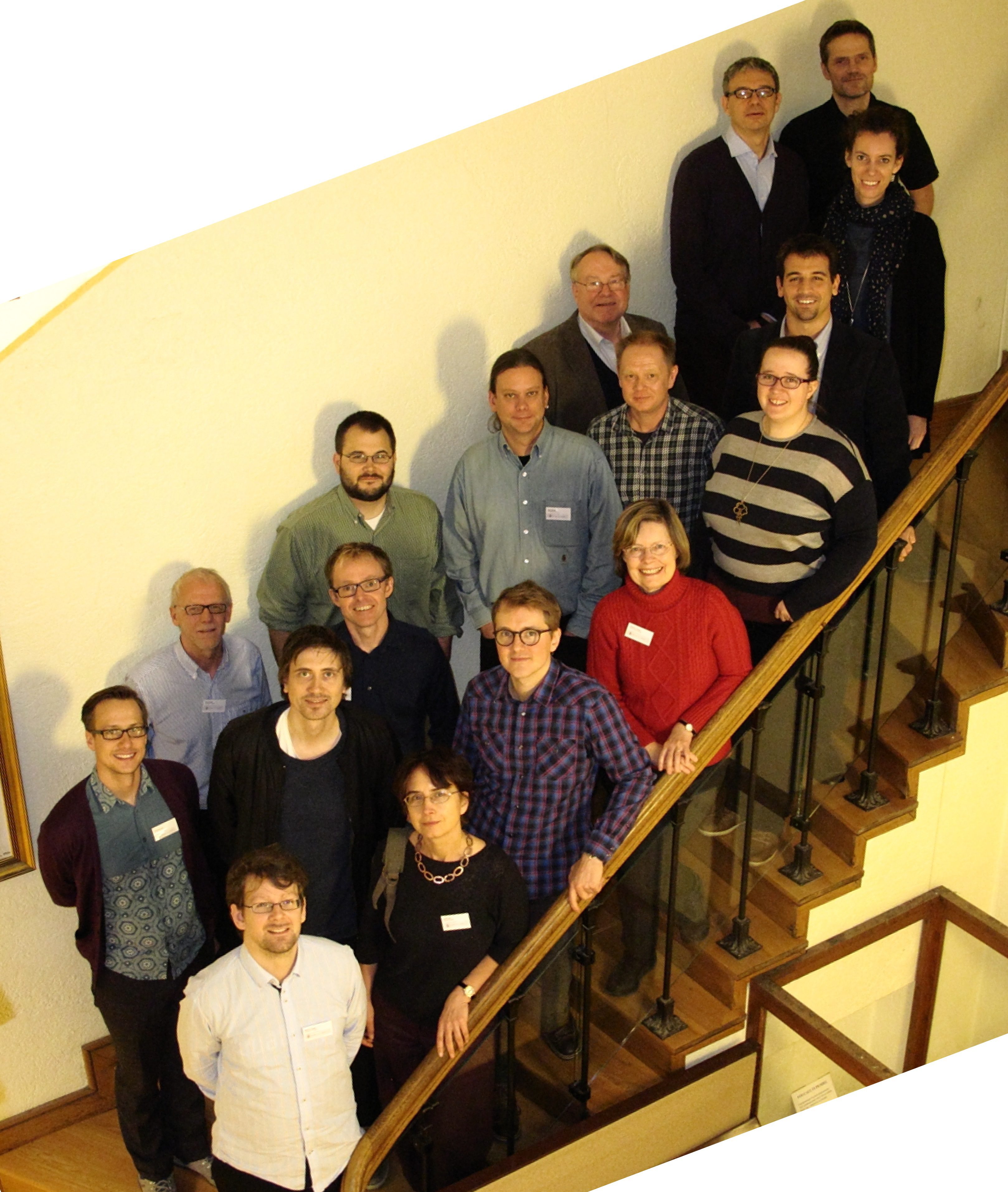
Attendees at the ‘Climate in meteorology, meteorology in climate studies’ workshop stood on the stairs in the University of Bergen’s Geophysical Institute, where many illustrious figures from the history of meteorology have previously stood (Photograph courtesy of Dania Achermann).
University of Warwick, 16 May 2015
CfP Deadline: 10 December 2014
http://warwick.ac.uk/RulingClimate
‘Ruling Climate’ aims to explore the relationship between cultural perceptions of the environment and practical attempts at environmental regulation and change between 1500 and 1800.
In the early modern period, the environment became a privileged locus of scientific debate and governmental action. Discussions spread across Europe and its colonies as to how to improve the land, and possibly even the climate of a given place; practical efforts were made to enhance the healthiness, productivity, and overall pleasantness of the environment (both natural and built) in the belief that environmental ‘improvement’, as it was then called, would immediately bring about human improvement—a larger, healthier, happier population that would make the country more powerful. Such debates and practices were driven by a persistent belief in the influence that landscape, weather and climate would exert on human beings, both at a physical and a spiritual level. ‘Climate theories’—first advanced by ancient authors such as Hippocrates, Plato, Aristotle and Ptolemy—remained a popular explanatory paradigm throughout the early modern period, actively dictating trends in environmental management, social governance, and the administration of both private and public health, as well as shaping colonial attitudes to foreign climates and peoples. Yet the period between 1500 and 1800 was also one of substantial intellectual, scientific, and technological change in which new conceptions of nature, climate, and weather were developed. The human footprint on Earth grew heavier, whilst the first moves towards conservation and sustainable resource management were made. Finally, it was in this period that changing climatic patterns were observed for the first time, partly because of a cooling trend that reached its peak around 1650 (the so-called Little Ice Age).
Lyman Briggs College (LBC), an undergraduate, residential, liberal arts, science program at Michigan State University, invites applications for a tenure-system assistant professorship in HPS of Computing, Networks, or Big Data, to be jointly appointed between the LBC and one of the following units: James Madison College or the Department of Geography. The candidate must have a background in the history, philosophy, or sociology of science, technology, environment, or medicine, and studies computational or network sciences as a subject illustrating core HPS topics such as: expertise and trust; methods of data collection and analysis; or, participatory GIS. We also welcome candidates who use natural language processing or social network methods for studying collaborative research and scientific production. The successful candidate will have an excellent record of teaching and research accomplishments and be committed to undergraduate education. Requirements include a Ph.D (or be scheduled to have a conferred Ph.D. by August 15, 2015) with expertise in the HPS of science, technology, environment, or medicine. Interests in non-western science and/or diversity and inclusion as related to science would be especially welcomed. Duties include teaching three HPS courses in LBC and one course in the joint appointment department, and maintaining an active research program. Salary and start-up support is competitive and commensurate with experience.
16th International Conference of Historical Geographers (ICHG)
Dates: Sunday 5 to Friday 10 July 2015
Location: Royal Geographical Society (with IBG), London, SW7 2AR
Website: www.ichg2015.org
News: Fleming in the Toronto Star
ICHM’s Professor Jim Fleming featured in this article about geoengineering in the Toronto Star.