An Invitation to Collective Research
By Hakan Akçura, founder of UNREGARDED and the Tor Bergeron Archive
More than ten years ago, while searching through flea markets in Stockholm, I came across two large boxes of old photographic negatives. I could not have known then that these fragile objects would lead me into the early history of modern meteorology, or that I would eventually find myself trying to identify some of the people who helped transform our understanding of the atmosphere.
The negatives belonged to a collection associated with the Swedish meteorologist Tor Bergeron (1891–1977), one of the pioneering figures of twentieth-century meteorology and the Bergen School.
I am a contemporary artist, not a meteorologist or a professional historian of science. My interest began with the photographs themselves: their material fragility, their extraordinary survival, and the lives they seemed to contain. Over the following decade, I carefully preserved, carried, examined, digitised and researched this collection, gradually recognising its historical significance.
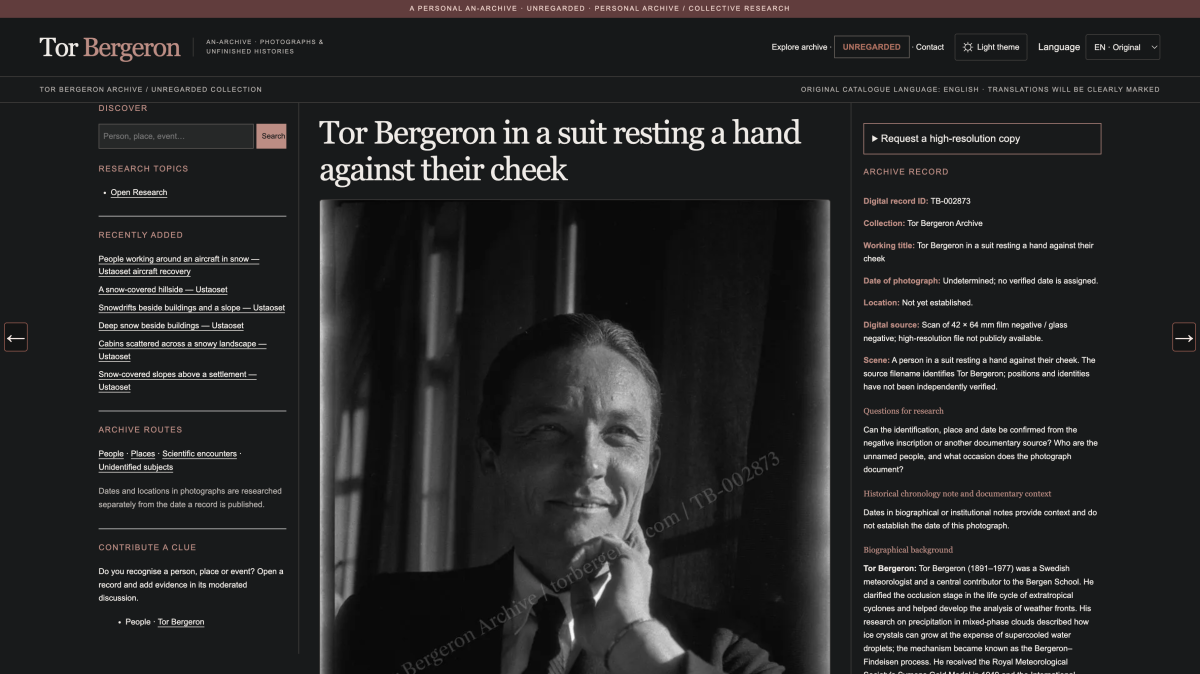
Today, I am delighted to share the result: TorBergeron.com, a publicly accessible photographic archive and an invitation to researchers everywhere to participate in the unfinished work of identifying its people, places, dates and events.
An unexpected visual history of modern meteorology
The collection contains approximately 1,700 glass and film negatives associated with Bergeron’s life and travels, principally from the first three decades of the twentieth century. Its historical importance extends far beyond portraits of an individual scientist.
More than 1,300 negatives document journeys, encounters and everyday situations connected with Bergeron’s professional and personal life, particularly between 1917 and 1930.
Among the people represented or identified in the surviving photographic records are Vilhelm Bjerknes, Jacob Bjerknes, Halvor Solberg, Björn Helland-Hansen, Carl-Gustaf Rossby, Anne Louise Beck, Kristine Bonnevie, Gunvor Færstad, Sverre Petterssen and Harald U. Sverdrup.
These names evoke an extraordinary period in atmospheric science, when new methods of weather analysis, theories of atmospheric circulation and approaches to forecasting were being developed through international scientific cooperation.
Yet what fascinates me is that the photographs do not simply illustrate these achievements.
They show people walking, travelling, eating together, relaxing, gathering in unfamiliar places and inhabiting the ordinary spaces between their professional activities. Some photographs suggest scientific expeditions or institutional meetings; others preserve informal relationships that seldom appear in published histories.
But what captivated me most was the sense of a remarkable, shared energy: scientists whose knowledge crossed disciplinary boundaries, setting out together in pursuit of clouds, driven by a collective spirit in which joy, determination and curiosity seemed inseparable.
The archive also contains images associated with wider scientific and exploratory networks, including material connected with Albert Einstein and the reception of explorer Sir Hubert Wilkins following the Nautilus expedition. The precise circumstances of some such images remain subjects for future investigation.
These photographs may allow historians to explore not only what scientists discovered, but how they lived, encountered one another and participated in the social world of scientific research.
Before Bergen: Lundsberg School, 1907–1909
One particularly remarkable part of the collection consists of approximately 350 glass negatives documenting life at Lundsberg School in Sweden between 1907 and 1909.
Bergeron was among the school’s early pupils. Long before his major scientific contributions, he was already making meteorological observations and photographing the world around him.
These early images offer an unusual view of school life from within: pupils and teachers, classrooms, sports, theatrical performances, group activities and everyday surroundings.
The Lundsberg photographs form an important historical collection in their own right. They also offer an opportunity to investigate the formative years of a scientist whose later work would become central to modern meteorology.
The school photographs and the later scientific material may illuminate one another, connecting Bergeron’s early observational interests with the social and intellectual environments of his subsequent career.
What the photographs still cannot tell us
Despite years of work, many questions remain unanswered.
When the negatives first came into my possession, they offered almost no clues to their origins. Neither the boxes nor their envelopes contained meaningful names or descriptions. A few negatives bore inscriptions scratched directly into their surfaces, occasionally indicating a year or a location. I did not even know whose collection I was holding. Only after scanning hundreds of negatives, did I gradually begin to recognise its connection to Tor Bergeron, and from that discovery, one clue led to another. Identifying the people in these photographs became a painstaking investigation that took months of online research, searching for the scarce surviving photographs of scientists in their younger years and comparing their faces, one by one, with those preserved in the negatives.
What now appears on the website as a collection of names and historical connections emerged slowly from images that, at first, seemed almost entirely silent. And despite everything I have learned, many identities, places, dates and circumstances remain unresolved.
I hope that historians of meteorology, researchers familiar with the Bergen School, institutional archivists, descendants and anyone possessing relevant documents will help address these gaps.
An identification might emerge from a published correspondence, an institutional photograph, a travel itinerary, a diary or simply another image taken on the same occasion.
I am especially interested in contributions that challenge existing descriptions. An archive becomes more valuable when its uncertainties are acknowledged rather than concealed.
Already, the first contributions from researchers have begun to enrich the records. I hope these exchanges will continue and expand.
Why I call it an an-archive
TorBergeron.com is the first extensively developed collection within a broader project I founded: UNREGARDED.
UNREGARDED brings together overlooked historical photographs and documents from different places, periods and subjects. Other collections already available include photographs of early twentieth-century Swedish town life, historical industrial and educational imagery, and German official press photographs from the First World War. Further collections are being prepared.
I describe this approach as an an-archive: not an archive without care or documentation, but one that refuses to regard its catalogue as the final word.
For me, preservation is only the beginning. A photograph should remain open to new evidence, correction, disagreement and reinterpretation. Its historical meaning should not be restricted to what a single collector happens to know.
Each photograph therefore belongs both to a collection and to an ongoing conversation.
I have spent more than a decade caring for these negatives, often thinking of them less as possessions than as something entrusted to me. Making them publicly accessible is my way of allowing that responsibility to become shared.
An invitation
I would be particularly grateful to members and readers of the International Commission on the History of Meteorology for visiting the archive, exploring its photographs and contributing their knowledge.
If you recognise a person, location, meeting, expedition or historical circumstance, please leave a comment on the relevant photograph, preferably with a documentary source. Corrections and alternative interpretations are equally welcome.
And if you know colleagues, institutions or families who may possess related photographic or written material, I would be grateful if you shared the archive with them.
Most of the Tor Bergeron collection is now presented online, but its historical reconstruction is far from complete. New evidence will continue to be incorporated, and further research may lead to exhibitions, publications and other forms of interpretation.
For more than ten years, these photographs remained in my care. Now I hope they can begin another life among the people best placed to understand them.
Tor Bergeron Archive: https://torbergeron.com/
?UNREGARDED: https://unregarded.org/
Hakan Akçura is a contemporary artist, independent archival researcher and founder of UNREGARDED, based in Sweden.