Categories
Conference Notes & Letters

Tsinghua University Holds Workshop on the History of Meteorology

By Xiao Liu and Wenzhe Zhang (Tsinghua University)

On April 11, 2026, the Third Workshop on the History of Meteorology was held at Tsinghua University. Hosted by the Department of the History of Science at Tsinghua University and co-organized by the International Commission on the History of Meteorology, the workshop was themed “Meteorology, Climate, and Environment: Exploring the Future Path of Research in the History of Meteorology”. It aimed to gather early-career researchers, students, and distinguished scholars to discuss and explore key developments, methodologies, and themes in the history of meteorology in China.

ICHM’s President Robert Naylor, and Vice President, Zhenghong Chen delivered welcome remarks online. While the workshop organizer, Xiao Liu (Tsinghua University), gave an introduction to the history of meteorology.

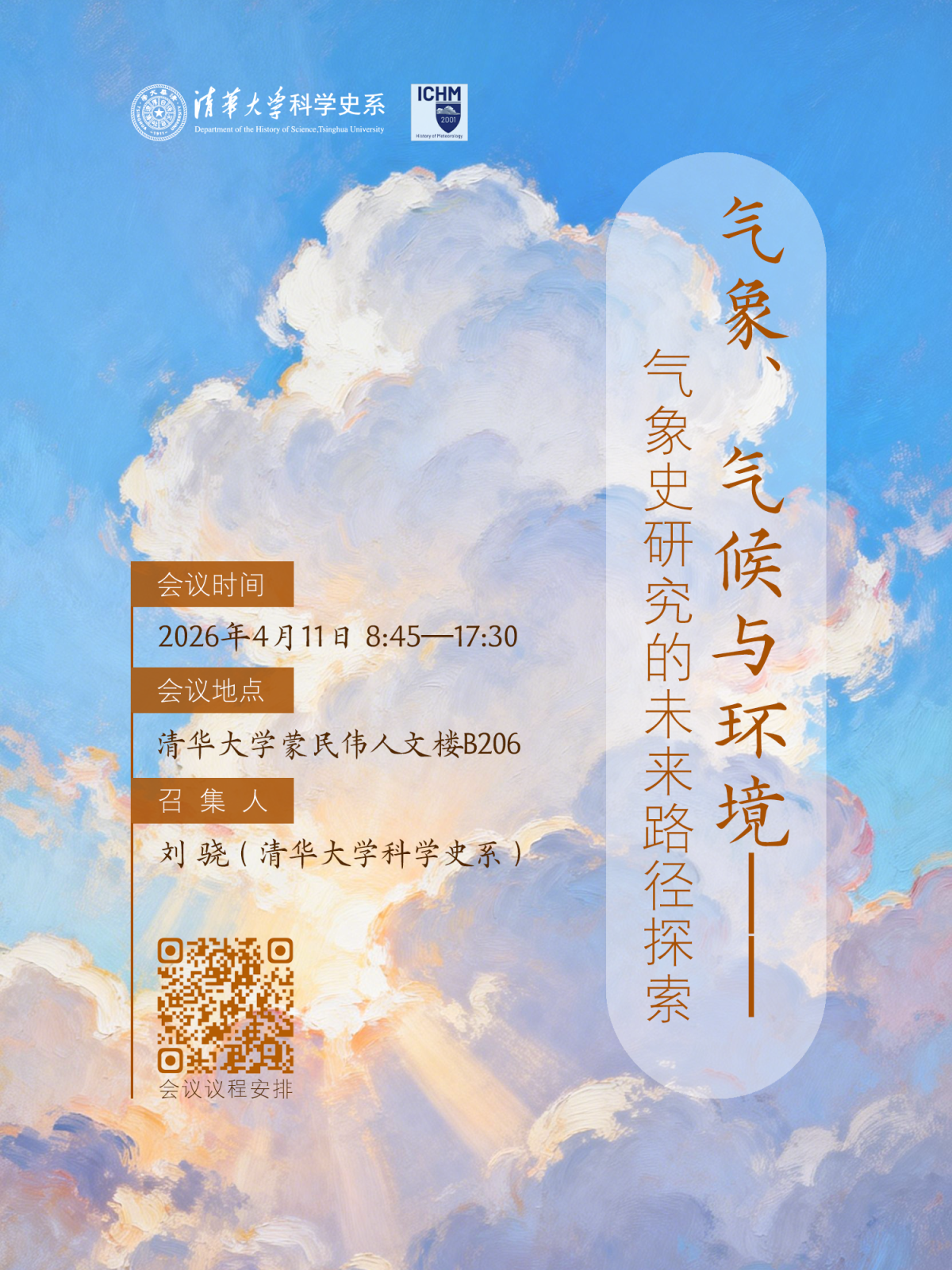
Poster in Chinese for the Third Workshop on the History of Meteorology at Tsinghua University.

The workshop opened with two keynote presentations.

The first keynote, by Associate Professor Hao Wang (Shanghai University) was a talk entitled “An Etymologic Study on the Word ‘Qixiang Xue’: Based on Western-Chinese Bilingual Dictionaries (1822–1922)”. In which, he traced the etymology of the Chinese term Qixiang Xue (meteorology), revealing the long, multi-channel circulation and negotiation of knowledge between Europe, China, and Japan. His talk was an excellent reminder of the interconnectedness of histories of science, reminding all present to always consider the history of cross-cultural contact from a global perspective.

In the second keynote, Associate Professor Zuoyan Cao (China Agricultural University) presented, “Famine Relief and the New Woman: A Study of Textile Production for Disaster Relief in the Taihang Base Areas during the War of Resistance against Japanese Aggression”. He argued that during the Second Sino-Japanese War, the Communist Party of China promoted gender equality and women’s emancipation through productive labor. By encouraging women to participate in spinning, weaving, and farming, the regime alleviated labor shortages and mitigated famine. These practices challenged traditional norms that confined women to domestic roles and assigned them inferior social status, helping to shape “new women” for a new society.

A photograph of the attendees at the Third Workshop on the History of Meteorology at Tsinghua University.

Selected Presentations

The workshop accepted open submissions, receiving more than 60 abstracts, of which 11 presenters and 10 papers were selected for presentation. Each selected paper was assigned a designated discussant.

  1. PhD Candidate, Jiaqi Wang (Yale University) presented “The Sky as the Earth’s Face: ‘Earthquake Clouds’ and China’s Universalist Environmental Outlook, 1966–1988”. As a discussant, postgraduate student Xiaoping Xue (Columbia University) commended the study for its sharp problem awareness, particularly its dialogue with the historiography of mass science and focus on earthquake rumors and social panic. She also raised questions about the specificity of seismology in this era and what the case reveals about the interplay among knowledge production, governance, and environmental perception in Mao?era China.
  2. PhD Candidate, Pengshan Tang (Hong Kong Polytechnic University) presented “Imagining ‘Shi qi (Dampness)’: Discourse, Culture, and the Body in 20th Century and Contemporary Chinese Contexts”. This study explored the emergence, transformation, and contemporary circulation of ‘shi qi’ as a bodily discourse in Chinese society. Discussant, PhD Candidate Qing Guo (Nankai University) commented that the paper illuminated the status of traditional environmental knowledge in modern China. He cautioned against the “curse of theory,” urging that grounded, lived experience should not be reduced to the footnotes of grand theories. He also emphasized that deepening the analysis of the online examples will be critical to strengthening the study’s scholarly impact.
  3. Postgraduate student, Qijia Shen (Renmin University of China) presented “Storms in the Far East: Knowledge, Power and Nationalism in Modern China’s Weather Forecasting, 1873–1937”. In which, she argued that the establishment and evolution of China’s modern weather?forecasting system between 1873 and 1937 was intertwined with the popularization of scientific knowledge, great?power competition for meteorological hegemony, the rise of Chinese national consciousness, and local scholars’ efforts to reclaim meteorological sovereignty.
  4. Associate Professor, Xi Liu (Xi’an Jiaotong?Liverpool University) presented a co?authored paper titled, “Realist Concerns and Narrative Types in Contemporary Chinese Climate Fiction”. In which, she outlined three representative themes of climate change in Chinese cli?fi narratives: flooding, cooling, and warming. Discussant Associate Research Fellow, Yanli Chu (Beijing Meteorological Society) observed that by constructing extreme fictional scenarios, cli?fi allows readers to rehearse crises from a safe distance, prompting reflection on collective action, just transition, and ecological civilization. It is not merely a cautionary tale but an experimental space for exploring how humanity can transcend divisions and pursue resilient coexistence.
  5. PhD Candidate, Xiaoyi Hang (Chinese Academy of Meteorological Sciences; Beijing University of Chinese Medicine) presented “Multi?Scale Impacts of Historical Climate Change on Infectious Diseases from the Holistic Perspective of ‘Correspondence between Heaven and Human’”. He argued that historical epidemic outbreaks in China were not caused by isolated environmental hazards but by cascading interactions between climatic anomalies (e.g., extreme cold and drought) and vulnerabilities in social systems, with famine serving as a critical amplifying factor.
  6. Postdoctoral Fellow, Wei Liu (Fudan University) presented, “Reconstruction and Mechanism of the Compound Extreme Precipitation Event in Northern China in 1654”. She concluded that: 1. The event combined persistent rainfall and short?duration extreme downpours, showing intra?seasonal superposition of distinct precipitation types. 2. Under a double La Niña and strong East Asian summer monsoon, remote typhoon activity contributed to moisture transport, analogous to the extreme July 2021 rainfall in Henan. Discussant, Lecturer, Zhilong Fang (Nanjing University of Information Science and Technology) noted that comparing the 1654 event with the 2012 extreme rainstorm in Beijing is highly illuminating. Given climatic differences in North China during the late Ming and early Qing, he suggested a systematic comparison between the 1654 event and other representative extreme precipitation episodes of that period to more fully uncover patterns and driving mechanisms.
  7. PhD Candidate, Hongbo Hao (Beijing Normal University) presented “A Study of Agricultural Meteorological Divination in the Han and Tang Dynasties: From Qin–Han Bamboo and Wooden Slips to Essentials of the Four Seasons”. His research focuses on the timing and subjects of agricultural meteorological divination in the Han–Tang period. It further links the divinatory logic of wind, clouds, qi, and rain to the theories of yin–yang, five phases, and Eight Trigrams (guaqi), aiming to reconstruct how meteorological divination shaped agricultural practice in the Han–Tang era. Discussant, Lecturer, Hongjun Liu (Institute for the History of Natural Sciences, CAS) commented that the reporter had a solid grasp of historical sources on agricultural meteorological prognostication during the Han and Tang dynasties, with reasonable categorization and a fair degree of persuasiveness. One suggestion was to avoid linear, single-narrative interpretations when analyzing texts from different sources, such as divination books, agricultural treatises, and official histories.
  8. Postdoctoral Researcher, Ziang Dong (Hokkaido University) presented, “A Land of Eternal Spring? Meteorological Surveys and Discursive Formation in Modern Yunnan across France, Japan, and China”. This study examines the construction of climatic perceptions of modern Yunnan through meteorological surveys by French, Japanese, and Chinese actors from the mid?19th Century to the 1930s. It argues that the label of Yunnan as a place of “eternal spring” is not a neutral climatic description, but a discourse produced via scientific measurement, print media, and affective politics. Situating these processes within the global expansion of modern science, the paper showed how French, Japanese, and Chinese actors competed over meteorological narratives, shaping modern climatic imaginaries of Yunnan. Discussant, Lecturer, Zhenwu Qiu (Nanjing Normal University) offered three suggestions: 1. The concept of zhangli (miasma?related illness) as a socially constructed climatic idea should be contextualized within the long?term historical interactions between Han Chinese and ethnic minority groups in premodern China. 2. Analysis of how France, Japan, and China produced knowledge of Yunnan as featuring “eternal spring” should address cross?national intersections and knowledge exchanges. 3. The trope of Yunnan’s “perpetual spring” persists today; while seemingly complimentary, it obscures the region’s climatic diversity.
  9. PhD Candidates, Liying Chen (Jilin University) and Shanglin Liu (University of Manchester) jointly presented, “Observing Celestial Phenomena to Survey Local Lands: Meteorological Observation, Agricultural Experiments of the South Manchuria Railway Company and Japanese Colonialism”. In which, they argued that the South Manchuria Railway Company established numerous agricultural experiment stations across Northeast China to conduct agricultural trials and agro?meteorological observations. These practices embodied the colonial logic of Japan’s long?term rule over Northeast China. Discussant, Dr. Qian Chen (Shandong University of Traditional Chinese Medicine) suggested that research on agro?meteorological observatories run by the South Manchuria Railway should analyze crop impacts on socioeconomic development to clarify their role in early 20th?century agricultural production.
  10. Postgraduate student, Jinfeng Liao (Shanghai Normal University) presented the research paper titled “The Seizure and Utilization of Japan‘s Military Meteorological Intelligence in China during the War of Resistance against Japan”. This paper pointed out that existing research has largely overlooked several core issues: how meteorological factors influenced Japanese military operations, how Japan acquired military meteorological intelligence on China, and how the Japanese military applied such intelligence during the Second Sino-Japanese War.
Following all presentations, the workshop concluded with a roundtable discussion that brought together all presenters and discussants for collective dialogue.

Professor Gang Fu (Ocean University of China), who is also the deputy Director-General of the Professional Committee of Meteorological Science and Technology History, emphasized that disciplinary development depends on precise conceptualization. Although modern meteorology has a century-long history, it was once not fully recognized as a formal discipline due to ambiguous core concepts, highlighting the essential role of clear definitions. He also noted that the integration of artificial intelligence and human expertise is pivotal: advanced AI tools have overcome language barriers in accessing foreign literature, creating improved conditions for research. He recommended incorporating the history of meteorology into atmospheric science curricula through dedicated courses. In summary, the history of meteorology carries great academic significance, and contemporary meteorological research will inevitably become the disciplinary history of the future.

Senior Engineer (Professor Level) Gaizhen Zhang (China Meteorological Administration Training Center), who is also the Secretary-General of the Committee on the History of Meteorological Science and Technology at the Chinese Society for the History of Science, observed that research themes and methodologies at both the Seventh National Symposium on the History of Meteorological Science and Technology (hosted by the China Meteorological Administration) and this workshop reflect the current state and future trends of meteorological history research in China, including colonialism, global history, and knowledge production and circulation. She called for stronger collaboration between meteorological historians and natural sciences researchers, as well as among scholars in history, cultural studies, philosophy, and other humanities and social science fields. She argued that by combining strengths in scientific accuracy, archival research, and theoretical reflection, the field can produce higher-quality scholarship. The committee pledged to provide robust support for members and researchers nationwide.

Associate Professor, Beibei Li (Nanjing University of Information Science and Technology) commented that the Tsinghua Workshop on the History of Meteorology has become a leading academic forum, offering an invaluable platform for rigorous peer review and scholarly dialogue. It is well-positioned to serve as a cornerstone for continued innovation and advancement in this dynamic field.

Regarding the function and role of research on the history of meteorology, Wang Bangzhong, who retired from the Department of China Meteorological Administration, responded to the question raised by the media for workshop. He said that looking both back into the past and ahead into the future will help the scientific and technical payoffs in terms of meteorological understanding contribute to improvements in the lives of the public. To close, workshop organizer, Xiao Liu delivered a concluding remark, thanking all presenters and reviewers for their participation. He called on researchers in the history of meteorology to further strengthen cooperation and academic exchange.

Categories
Conference Notes & Letters

Crisis Critiques

Workshop Report: “Climate & the Beginning of the Crisis Decades: Climate Research & Discourse During the 1970s,” Manchester, August 30, 2024

By Robert Naylor (University of Manchester and University of Cambridge), Elliot Honeybun-Arnolda (Technical University of Munich), and Ruth Morgan (Australian National University)

Due to the generous support of the International Commission for the History of Meteorology and the British Society for the History of Science, Manchester’s Centre for the History of Science, Technology and Medicine (CHSTM) was able to host a workshop exploring climate research and discourse during the crucial but often-neglected decade of the 1970s.

The 1970s have been argued to be a period of political, economic, scientific, and cultural transition. Daniel T. Rogers has described the 1970s as the beginning of an age of fracture, when the discursive, economic, and political landscape was torn apart and reformed. Eric Hobsbawm has written that the 1970s heralded “a world that lost its bearings and slid into instability and crisis.” It is during this decade that climate change narratives began to emerge into the political spotlight. As shown by scholars such as Spencer Weart and Joshua Howe, reasons for this increase in status include the rising influence of the environmentalist movement, neo-Malthusian fears of population explosion supposedly accentuated by adverse climatic effects on crop yields, and (controversially) the usefulness of climate change arguments for the nuclear power lobby during a time of energy and oil crisis.

Categories
Conference

Climate & the Beginning of the Crisis Decades

A one-day workshop that seeks to generate critical transdisciplinary engagement around climate research and discourse in the 1970s

Friday, 30 August 2024, 9-5pm
CHSTM Seminar Room: Simon 2.57 [maps and travel]

Organisers: Robert NaylorElliot Honeybun-ArnoldaRuth Morgan

Please register here to attend in person
Please register here to attend online

Open to a range of disciplinary backgrounds, this workshop concerns the resonances of climate-based narratives and the growth of climate research during the long decade of the 1970s. The 1970s have been acknowledged as a period of political, economic, scientific, and cultural transition. Daniel T. Rogers has described the 1970s as the beginning of an age of fracture, when the discursive, economic, and political landscape was torn apart and reformed. Eric Hobsbawm has written that the decade heralded “a world that lost its bearings and slid into instability and crisis.” It is during this time of crisis that climate change narratives began to emerge into the political spotlight. As shown by scholars such as Spencer Weart and Joshua Howe, reasons for this increase in status include, as a few examples, the rising influence of the environmentalist movement, neo-Malthusian fears of population explosion supposedly accentuated by adverse climatic effects on crop yields, and (controversially) the usefulness of climate change arguments for the nuclear power lobby during a time of energy and oil crisis.

Categories
Conference Opportunities

Insular weathers, global atmospheres: Exploring the aerial histories of islands

Atmospheric Humanities Conference II

1-3 November 2024

Historical and Popular Art Museum of Aegina, Greece

Small island countries in the Caribbean and the Pacific and Indian Ocean have always been exposed to extreme weather, but the last decades have made it clear that they are also the biggest future victims of climate change. However, islands are also key sites in the history of science. Much weather and climate knowledge derives from island sites. When European and North American countries started launching weather balloons around 1900 to measure the upper atmosphere, next to ships, islands formed key launching sites. Islands were ideal places to measure the interaction of the global atmosphere, the land and the ocean. The Keeling curve was the result of decades of accurate and continuous measurements at Mauna Loa observatory on Hawaii. Moreover, islands have also became important meteorological metaphors: think about ‘heat islands’ in urban cities, where microclimates create islands where before there were none.

Categories
Conference Notes & Letters

Call for Papers: Climate, Food & Famine in History

By Robert Naylor and Eleanor Shaw

Open to a range of time periods and disciplinary backgrounds, this workshop is concerned with the history of climate-orientated narratives in relation to food and famine. At a time of rebounding climate discourse, the use of climate-orientated narratives as explanatory devices for food shortages and famine has come under increased scrutiny. UN Secretary General Ban Ki-moon attracted criticism in 2007 when he attributed the Dafur conflict to climate change-induced food insecurity. More recently, in 2015, Barack Obama controversially used the Syrian civil war as an example to frame climate change as a security problem: ‘It’s now believed that drought and crop failures and high food prices helped fuel the early unrest in Syria, which descended into civil war in the heart of the Middle East. So, increasingly, our military and our combatant commands, our services […] will need to factor climate change into plans and operations.’ In 2021 the World Food Programme website claimed that families ‘are stuck in a cycle of conflict, climate shocks and rising levels of hunger’ in relation to the ongoing famine in South Sudan. This workshop aims to bring academics together to provide historical context for such claims.

Relevant work includes Mike Davis’s Late Victorian Holocausts, which argues, for example, that research into hypothetical sunspot-driven climatic changes was utilised to help excuse British authorities who oversaw the Great Famine in India. Philip Slavin (2019) has presented a complex picture of the British famine of 1314-17, where agriculturalists had to face unrelenting taxes and forced food sales alongside an inclement climate. Critiques of climate attribution theses have a long history, with meteorologist Rolando Garcia’s 1981 work Nature Pleads Not Guilty disputing the climate attribution thesis of food insecurity in the 1970s. More recent work by Jan Selby, Omar Dahi, Christiane Fröhlich, and Mike Hulme has interrogated the climate attribution thesis of the Syrian conflict, arguing that policymakers should exercise greater caution when drawing such links. Even more recently, Myanna Lahsen and Jesse Ribot (2022) argued that ‘climate-centric disaster framing can erase from view—and, thus, from policy agendas—the very socio-economic and political factors that most centrally cause vulnerability and suffering in weather extremes and disasters.’

Such discussions are rich, but often suffer from being siloed in isolated academic subjects and institutions. This workshop aims to bring together scholars across disciplines to critically examine powerful and controversial climate-based narratives around food insecurity that have long permeated public discourse.

This is an intimate 1-day event that seeks to assemble individuals with various research backgrounds (e.g. environmental history, HSTM, social sciences, atmospheric science) in an effort to generate critical transdisciplinary engagement around the intersection between climate, food, and famine in history.


April 14, 2023, 9:00-16:00 BST

Room 2.57 Simon Building, University of Manchester, UK

Deadline for abstracts (300 words): December 15, 2022


Registration information for non-presenting participants will be circulated at a later date.

Format: 20-minute presentation followed by 10-minutes of discussion at the end of each panel. 50-minute roundtable to finish proceedings.

Please send your submissions and any queries to Robert Naylor and Eleanor Shaw (conference organisers): climate.food.famine@gmail.com

A limited number of travel bursaries are available (with priority for early career researchers). Please email the above address for details. In the first instance this is an in-person event. However, if you wish to contribute but cannot travel please email the above address.
Categories
Conference Seminar

Atmospheres: a series of art-science interactions

NEXT EVENT – April 30, 2019

Our next Atmospheres presentation will be by Dutch artist Berndnaut Smilde on Tuesday 30 April @ 1 PM, at the University of Manchester (Building: Coupland 3, Lecture Theatre B)


Categories
Conference

Painting the clouds, from the dawn of the Enlightenment to the twilight of romanticism

On January 16, 2018, a diverse group of scholars including art historians, literature experts and historians of science met at the Musée Delacroix in Paris for a workshop entitled: “Peindre les nuages, de l’aube des Lumières au crépuscule du romantisme” (or Painting the clouds, from the dawn of the Enlightenment to the twilight of romanticism).

Sponsored by ICHM, below the workshop organiser Anouchka Vasak summarises and reflects on the meeting. For a full schedule of the event, please scroll down.